Thursday, October 1, 2015

Fuji-san (Days 137, 138)

Day 137 was pretty much all transportation. We took a bus from the hostel to Kyoto Station, then shinkansen (bullet train) from Kyoto Station to Mishima Station (south of Mt. Fuji), then a charter bus from Mishima Station to Yamanakako (lakeside town ENE of Mt. Fuji) and then walked about a mile to our guest house.


An outlying neighborhood of Kyoto, taken out the window of the shinkansen.


One of the more "rural" areas we passed by on shinkansen.

As I said before, the shinkansen took us as far as the south side of the mountain. We then took a bus around the mountain to the northeast side, to a small town called yamanakako. Then there was about a mile or so long walk to our guest house with all of our luggage. The guest house was awesome. I have some pictures on my phone that I may put on a later post, but none in my camera. We slept on traditional futon (bedrolls) on tatami and it was surprisingly comfortable. The bathroom was the best part though. In traditional Japanese houses the room where you bathe and use the toilet are separate (seems kind of logical if you think about it). As such, the entire bathroom is dedicated to cleaning yourself and just has a drain in the middle of the floor. Our bathroom had 4 shower heads and a huge tub in the corner. You basically scrub yourself clean in the shower and then soak in the tub for awhile. It's supremely relaxing, especially after long days of traveling, hiking, and mountain climbing.

Unfortunately, we couldn't find anything online about bus service to the mountain trail from our lodging. So, the next morning we got up early and walked all the way (10 km) to the nearest train station to take a train to the nearest bus hub to take a bus to the mountain's fifth station (about halfway up the mountain). Fortunately, the walk was very scenic. Here's a couple pictures, but they don't really do it justice:


The intensely weird train we rode to the bus hub.


Note the decidedly normal looking conductor.

So, we took a bus about halfway up the mountain (pretty much everyone does this unless they're masochists or something). Finally, we started our climb. There are 10 stations (numbered 1-8, 8.5, and 9) and you start from the fifth station. At the 6th station I donated 1000 yen to conservation for the mountain and got a sweet pin.


Even from the start point we were up in the clouds. This is somewhere above the 6th station.


This is a bit higher, probably above the 7th station. Vegetation is sparse.


I believe this was above the 8.5th station. Maybe change the sign to say "fallen rocks?" This looked really ominous.


This looks like pictures sent back from the the Curiosity Rover doesn't it?


Very near the summit. The clouds parted for a moment. We passed the rotted remains of a hut at one point that was completely smashed by a boulder. We later learned that was 9th station. Hopefully no one was inside at the time. At this height the lack of oxygen was really apparent. I was breathing like I was sprinting and I was moving very slowly.
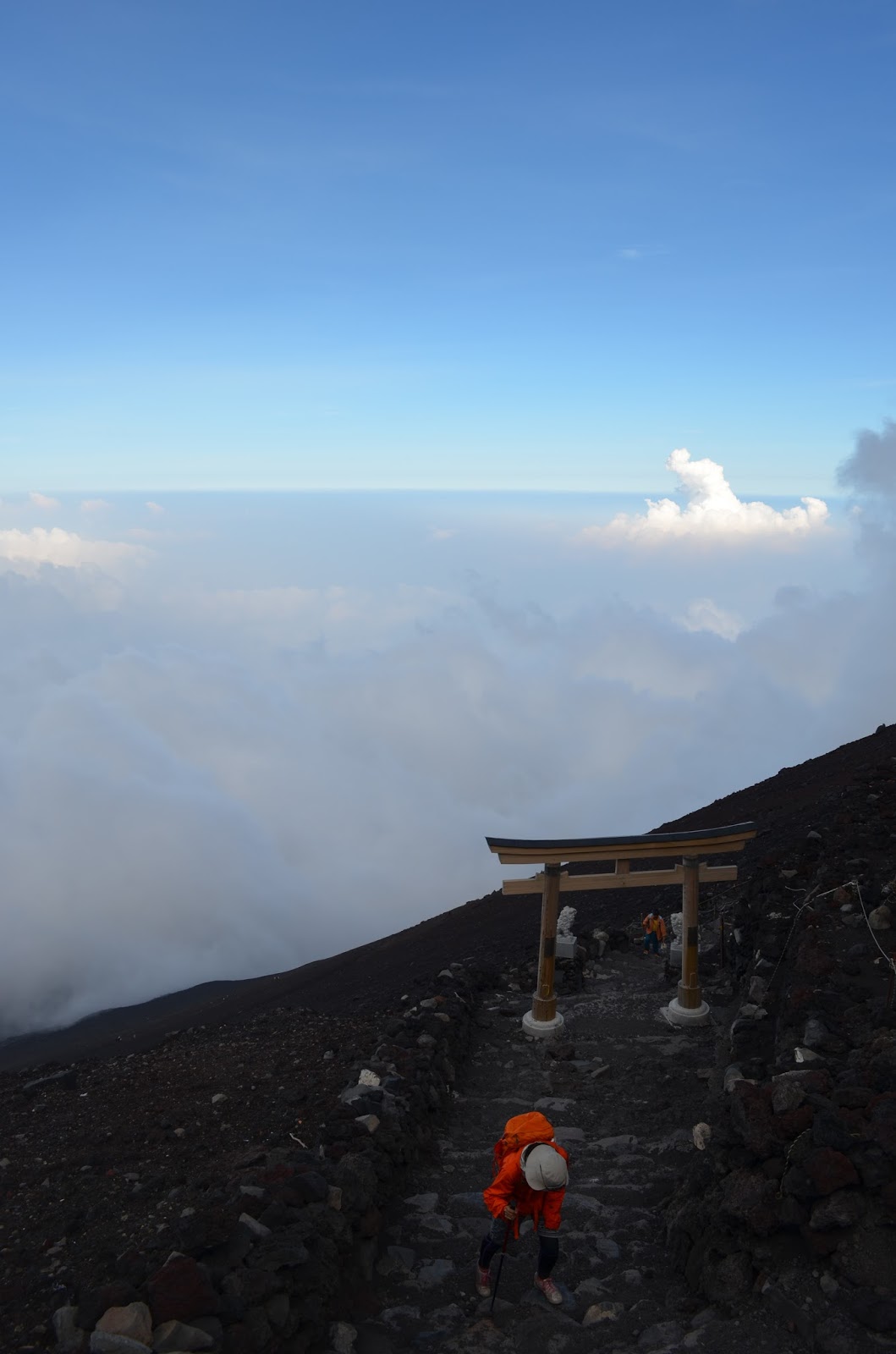

This is the gate at the summit. There's about 20 more steps before you're actually on top.


Looking right from the previous picture.


The shrine at the summit. You bet I got that stamp. It was 1000 yen (~$8). Usually they're 300 (~$2.40). Honestly though, I would have paid pretty much any amount for it.


Panorama of the caldera at the summit. Oh, by the way, Fuji is a volcano if you didn't know.


Victory!


Looking over the edge.

From here, we started to descend. We didn't linger long at the summit, as we didn't want to be descending in the dark and Ed was struggling with the thin air. We got him a can of oxygen, but he was still a little loopy. 

Stephen and I were dumb though, and we wore stupid shoes. I mean, I didn't have any proper hiking boots, but I knew I was climbing Fuji so I should have bought some. The descent is supposed to be fun filled for prepared climbers, as it's just a bunch of crushed pumice. With the proper shoes you can slide down the mountain in under two hours. With sneakers, your shoes get destroyed and you have to stop every 100 feet to dump rocks out of them. So, the descent took us about 3 hours, except for David who went ahead and had enough time to eat a meal at the 5th station while waiting for us. Still got a couple awesome panoramas though:


Panorama taken from the slope a few hundred feet down.


Panorama taken from very near the 5th station at sunset.

That's all for now folks. Next time, Tokyo!

Wednesday, September 30, 2015

More touring with friends! (To-ji again, Byodo-in, Osaka Aquarium, Sumiyoshi-taisha) (Days 135, 136)

I already had a bunch of stuff on yesterday's blog, so I put the tail end of that day into this blog. We went from Kinkaku-ji to To-ji. I already posted a bunch of pictures of To-ji (biggest wooden pagoda) back in March, so go there and check those out if you haven't already. From there we went to Fushimi Inari-taisha which I also already posted a bunch of pictures of (lots of red gates on a small mountain). I got a couple other good pictures that day though, so those are the first three posted here.


When I visited To-ji before, the lotus weren't in bloom. So, I snapped a shot of them. 


At the train station on the way to Inari I found a cicada on the ground, These guys were deafening, by the way. If you stand under the wrong tree, you literally cannot hear the person standing next to you talk.


I flipped him over. He was alright.

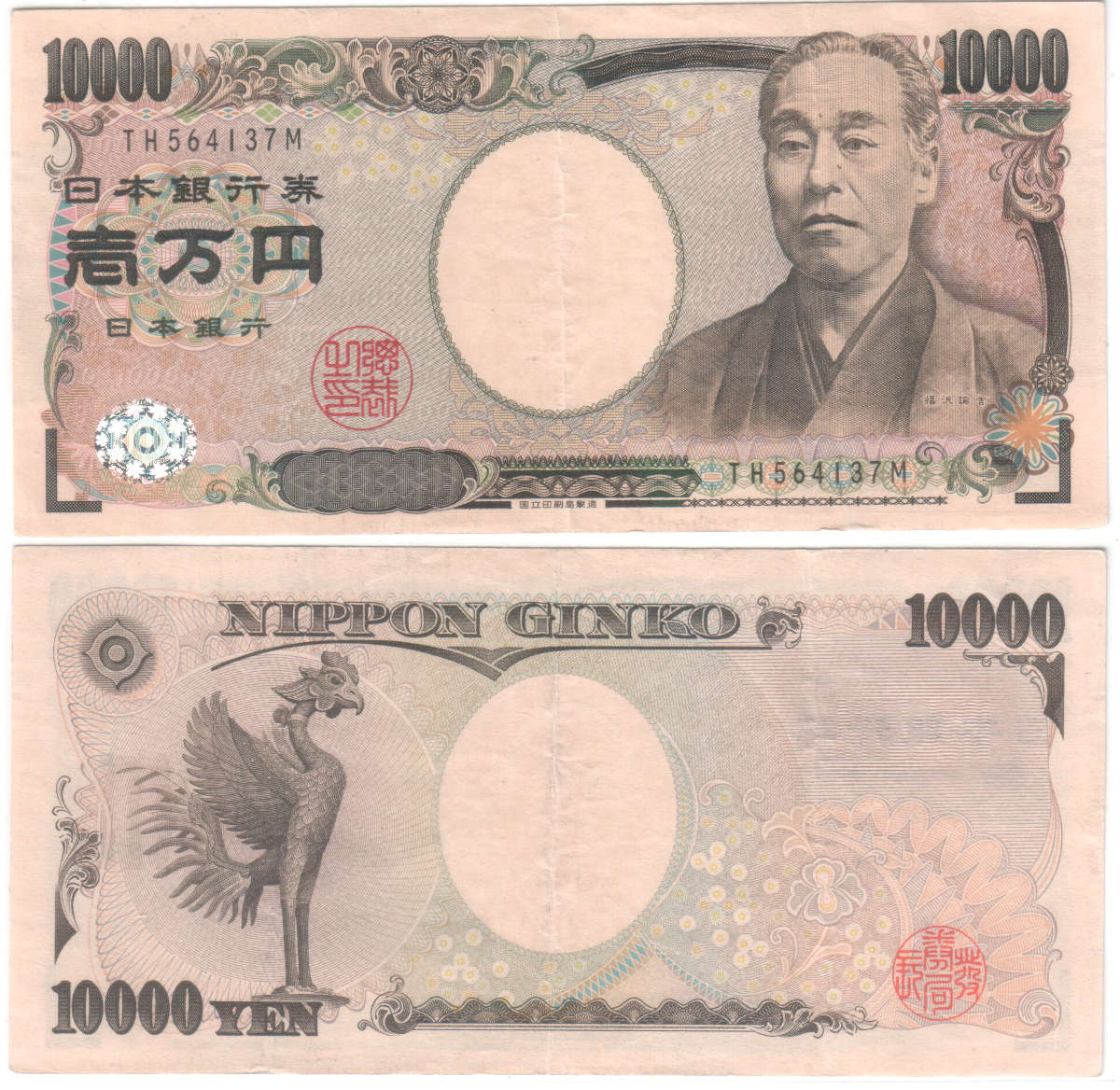
The next day we got up early and went to Uji (a small city neighboring Kyoto) to see Byodo-in. Byodo-in is a Buddhist temple which houses the famous Phoenix Hall (pictured below). The Phoenix Hall is pictured on the ten yen coin, and the phoenix himself is on the 10000 yen note. The phoenixes can just barely be seen on top of the central section of the hall. There was also a really awesome museum, with tons of statues of little bodhisattvas flying around on clouds, but you couldn't take pictures in there.


You can see some people visiting the inner chamber of the hall here. It only cost a little more money to go in, but there was a wait. Being that it was over 100 degrees, we decided to skip it.


Here you can see the temple reflected in the pond surrounding it.


You can faintly see the giant Buddha sitting inside the hall. You can also see the phoenixes on top of the hall a bit better. Apparently, centuries ago people would bring the dying here to help guide them to paradise.

We then left Uji and headed to Osaka where we visited the world famous aquarium there. My pictures there mostly kind of sucked because of reflections and dirty glass, so I edited them pretty heavily to not look so sucky. Still you can see reflections and stuff, oh well.


Aren't these things creepy? They're huge, by the way. Not sure if you can tell, but those legs are like six feet long.


These jellies were also kind of creepy. Not much more to say there.


These two were the main attraction. The whale sharks! They were in the biggest aquarium I've ever seen, and still it wasn't big enough for them. I believe that when they reach adulthood the aquarium releases them and adopts new babies to replace them.

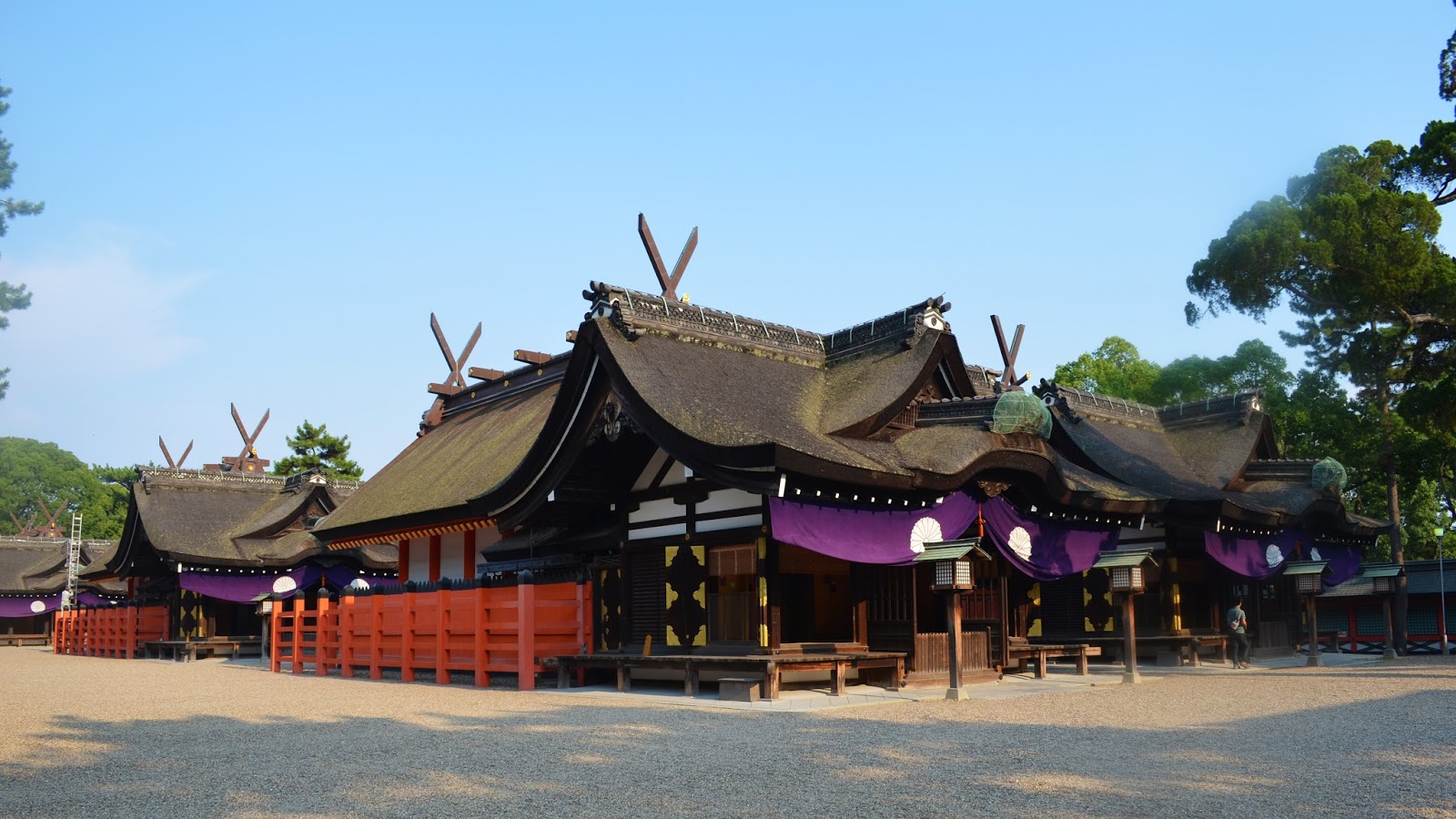
From the aquarium we went to Sumiyoshi-taisha, one of the oldest shrines in Japan. It predates Chinese influence, and thus has a uniquely Japanese architecture. This bridge especially is pretty neato.


I just liked this picture. It's very Japanese. Modern and ancient stuff just thrown together all hodge podge. Also, you can maybe get an idea of how many people ride bicycles from this picture.

Until next time! (Tomorrow is Fuji, get hype!)

Tuesday, September 29, 2015

Touring with friends, Genko-an and Kinkakuji (Part deux) (Day 135)

So, after the school year wrapped up, my friends David, Stephen, and Ed came to visit. For the first few days we explored Kyoto and neighboring cities Uji and Osaka.


There's David feeling the zen, in the courtyard of Genko-an.

Genko-an is a buddhist temple north of Kyoto with a couple noteworthy features. First, the ceiling of the temple is made from the old floorboards of Fushimi Castle. At that castle 2,000 samurai held off 40,000 men for 11 days, long enough that their lord Tokugawa Ieyasu could escape. Tokugawa would go on to unify the fragmented country, leading to over two hundred years of (relative) peace.

The last few men standing at the end of the siege commit seppuku (ritual suicide), rather than be captured by their enemies. Today, over 400 years later, you can see their bloodstains on the ceiling of Genko-an.


One of the most striking stains, you can clearly see a footprint here.


The other feature that draws a lot of visitors are the windows of confusion and enlightenment. I'm sure it bears a lot more significance for practitioners of Buddhism. They are supposed to relate to one the benefits of an enlightened perspective. I'm not sure I felt enlightened, but they were pretty cool.


The Window of Confusion


The Window of Enlightenment


Side by side


We then went to Kinkaku-ji. It's a tourist trap, but it's a must see. So, I showed them around but tried not to linger. There were a buttload of Chinese tourists there.


From left to right: David, Stephen, and Ed.


Sort of a dry wishing well. People stand behind a nearby rope and try to toss 1 and 5 yen coins into the pot.

Monday, September 28, 2015

Gion Matsuri! (Day 119)

The whole month of July is filled with Gion related festivities, with the main event being the parade on the 17th. Three days before the parade, the main streets are shutdown to normal traffic, and the entire downtown area is inundated with pedestrians and street vendors. I wasn't able to make the parade due to typhoon, but I did check out the festivities on the 16th.


Here are some of my friends (from left to right): Guillermo (Spain), Haruna (Japan), Lena (Germany), Clara (Germany), Yuri (Japan), Kenji (Taiwan), and Oscar (Bolivia). Also present but not pictured were Adam (Michigan), Nick (Michigan), and Felix (Germany).


It was insanely crowded. State Fair doesn't compare.


You saw lots and lots of people in traditional clothing.


You can see the rows of food vendors that seem to go on endlessly. In the foreground you can see Adam's novelty Taiyaki hat. Adam is a very large guy, well over 6' 0" and built like a lineman. He drew a lot of attention with this hat, which was actually only one in a collection of silly hats. He was constantly stopped and asked for pictures, and you could hear people whispering "sugoi" (amazing) and "deke" (huge) as they passed him.


Adam's hat again. Here you can see some people checking it out and Lena laughing at him.


Some kimono.

It was really unique being a part of that crowd and all of that energy. The collectivist culture in Japan makes it feel like you're really part of the crowd and part of the event.